[Client]
Mobil (ExxonMobil) — Mobil 1 Triple Action Power+
[Year]
2026
[Services]
3D Product Visualization, Liquid Simulation, Generative AI Content, Compositing, Colour Grading
[Catagory]
3D Animation

Mobil 1 Seal Campaign: 3D Product Visualization & Hybrid AI Animation
Client: Mobil (ExxonMobil) · Product: Mobil 1 Triple Action Power+ 0W-20 Ultimate Full Synthetic
Year: 2026 · Category: 3D Animation / AI-Content
Services: 3D Product Visualization · Liquid Simulation · Generative AI Content · VFX Compositing · Colour Grading
Overview
FireDrum Studios — a 3D animation and VFX studio based in Dhaka, Bangladesh — produced the Mobil 1 Seal campaign, a fully CG product film built around a single idea: you cannot photograph what motor oil actually does. The protective seal that full synthetic oil forms across a running valvetrain lives a few microns thick, inside a sealed engine, at temperature. So we built it.
The film moves from a hero shot of the Mobil 1 Triple Action Power+ bottle resting on a car bonnet, down into the engine itself, where a simulated oil film coats valve springs, stems and camshafts in real time — then back out to the open road, where the car it protects is driven through a city skyline at golden hour. Every frame is computer generated. No plate photography, no product shoot, no location unit.
The Creative Challenge
Motor oil is a low-interest category with an invisible product benefit. The brief asked for three things that usually pull in opposite directions:
Pack fidelity. The Mobil 1 bottle is a registered asset — gold HDPE, honeycomb embossing, a printed label with API SQ, ACEA C5 and ILSAC GF-7A certification marks. Nothing could drift.
A visible benefit. "Triple Action Power+" had to read as a physical event, not a claim on a lower third.
Automotive-grade exteriors on a product-film budget. The campaign needed a premium SUV on a highway — a shoot that normally costs more than the rest of the film combined.
Our answer was a hybrid pipeline: traditional 3D where precision is non-negotiable, generative AI where the shot only has to feel real, and an AI-assisted finishing pass that lifts the renders without letting them drift from the approved look.
Solution: Simulating the Seal
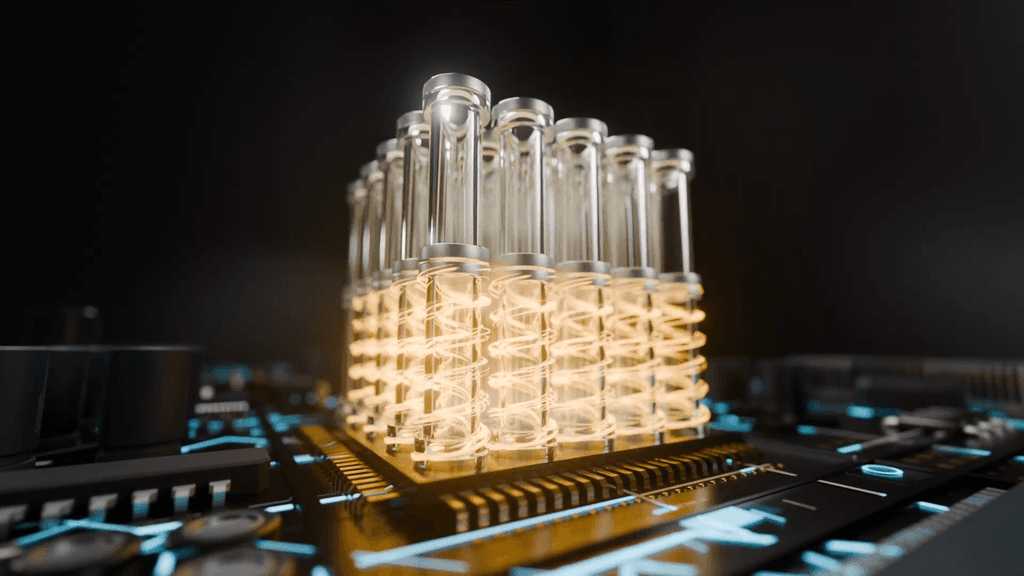
The engine sequence is the spine of the campaign. Rather than illustrate lubrication with a diagram, we treated the oil as a character.
The valvetrain was modelled and shot as a macro environment — a corridor of springs, retainers and valve stems lit with hot orange bounce so the metal reads as a working engine, not a CAD viewport. Oil was then simulated pouring, clinging and beading across the geometry, with surface tension and viscosity tuned to a 0W-20 grade so the film behaves like thin synthetic oil rather than syrup. What the viewer sees is the seal forming: a continuous golden skin that closes over every contact surface and stays there.
That single visual carries the product claim without a word of voiceover.
Technical Breakdown
3D Product Visualization — Blender
The hero bottle was modelled to pack drawings and shaded with a layered plastic material: a gold base with anisotropic roll, a clear-coat pass for the moulded highlights, and a separate label shader carrying the printed artwork at press resolution so the Mobil 1 lockup, the 0W-20 callout and the certification block all hold up at full frame. Lighting is a two-bar studio setup raked across a dark reflective bonnet, chosen so the gold reads metallic without blowing out the white label field.
Liquid Simulation — Houdini
The oil was simulated in Houdini as an FLIP fluid, art-directed in passes rather than solved in one shot:
Flood pass — bulk oil travelling down the valvetrain corridor, establishing motion and direction.
Cling pass — thin-film adhesion on springs and stems, the layer that actually sells "seal."
Detail pass — beads, drips and stretched filaments at the valve heads, retimed for the hero moment.
Meshing and velocity data were exported to the render layer so the shading could carry real refraction and subsurface transmission instead of a faked glossy shell.
Generative AI — Exterior Driving Footage
The full exterior sequence — the dark SUV moving along an elevated highway against a city skyline — was produced with generative AI. It is the one part of the film where the audience needs plausibility, not accuracy: no client-owned vehicle design, no product in frame, no claim being made. Generating it removed a location shoot, a camera car and a grip package from the schedule, and let us direct the light to match the interior sequence rather than the other way round.
Hybrid Workflow — MiniMax H3 with ControlNet
This is the part of the pipeline we are most interested in. For selected product shots, the approved Blender render was passed through a locally hosted MiniMax H3 model driven by ControlNet conditioning — depth, normal and edge maps taken straight from the render's own AOVs.
Because the conditioning comes from the 3D scene, the model cannot invent a new bottle, move a highlight or redraw the label. It re-renders the same frame with the micro-detail that separates a render from a photograph: dust settling in the mould lines, subtle chromatic falloff at the plastic edge, a softer transition where the bonnet reflection dies. The output is a photoreal version that matches the 3D render shot for shot, so the two can be cut against each other — or blended — without a visible seam.
Running the model locally kept every frame of an unreleased pack design inside the studio.
Compositing, Grade and Finish
After Effects — beauty, reflection, AO and cryptomatte passes assembled per shot; typography, brand lockups and the closing pack build.
DaVinci Resolve — final colour grade unifying three very different image sources (native 3D render, AI-generated exterior, AI-enhanced product frames) into one campaign look: warm gold in the product and engine beats, cooler blue steel on the road.
The grade is what makes the hybrid pipeline invisible. Once the whole film shares a single contrast curve and gold-to-blue split, the audience stops being able to tell which shot came from which process — which was always the point.
Tools & Pipeline
Stage | Tool |
|---|---|
Modelling, shading, lighting, rendering | Blender |
Liquid and oil-film simulation | Houdini (FLIP) |
Generative exterior footage | Generative AI video |
Photoreal enhancement pass | MiniMax H3 (local) + ControlNet |
Compositing, typography, motion graphics | Adobe After Effects |
Colour grading and finishing | DaVinci Resolve |
Results
A complete automotive-grade product film delivered with zero live-action photography — no product shoot, no location unit, no camera car.
An invisible product benefit made visible, with the protective oil seal carried as a simulated physical event rather than a supered claim.
A repeatable hybrid AI + 3D pipeline that holds brand-critical pack fidelity while borrowing photoreal micro-detail from a locally hosted diffusion model.
Shot-matched photoreal and CG versions of the same frames, giving the client two finishing options from one render.
Why Brands Choose FireDrum Studios for 3D Product Visualization
Since 2016, FireDrum Studios has built CGI, VFX and 3D animation for brands including City Bank, Realme, Pran-RFL, Proton, Berger and Heidelberg Materials. The Mobil 1 Seal campaign is part of an ongoing body of hybrid AI work — alongside Ruby Cement PCC Max and Proton Charger 3D Product Visualization — where generative models and traditional pipelines are used for exactly what each does best.
Planning a product film that has to look photoreal and stay on-brand? Let's talk.