CGI Animation Mastery: FireDrum’s Secrets for Stunning Visuals
[BY]
Tahmid Khan Alim
[Category]
Tips & Tricks
[DATE]
Discover the creative and technical secrets behind high-end CGI. From pre-production to final compositing, learn how a top 3D Animation Studio in Bangladesh crafts stunning visuals.
The Magic Behind the Pixels
Have you ever watched a scene so visually arresting that you forgot you were looking at pixels on a screen? That moment where the lighting hits a character’s face just right, or the texture of a rusted robot feels so tactile you want to reach out and touch it—that is the sweet spot. That is where technology bows down to storytelling.
At FireDrum Studios, we live for that moment.
Based here in Dhaka, we’ve spent years refining the delicate dance between art and algorithms. As a 3D Animation Studio in Bangladesh working with global clients, we know that "stunning visuals" aren't just about having the most expensive software. It’s about the philosophy, the pipeline, and the hundreds of tiny decisions made by artists who care.
Whether you are a client curious about how the sausage is made, or an aspiring artist looking to level up your game, we’re pulling back the curtain. Here are the secrets behind our CGI animation mastery.
The Philosophy: Story First, Pixels Second
It’s tempting to get lost in the tech. We love a good fluid simulation or a complex node graph as much as anyone. But the first secret to mastery isn't technical; it’s philosophical.
If it doesn’t serve the story, cut it.
We approach every project with a "story-first" mindset. A photorealistic render of a chair is just a chair. But a chair with a worn-out seat cushion, cast in moody, long shadows? Now you have a narrative. Who sat there? Why is the room empty?
Balancing Realism and Stylization
There is a misconception that "better" CGI always means "more realistic." That’s false. The goal is believability, not necessarily reality.
Hyper-realism: Required for VFX integration where a CG car needs to match live-action footage perfectly.
Stylized: Think Spider-Verse or Arcane. The physics might be exaggerated, but the emotion feels real.
We focus on internal consistency. If the world is stylized, the lighting and motion must follow the rules of that specific world.
Pre-Production: The Blueprint for Success
You cannot build a house without a blueprint, and you certainly can’t build a 3D world without pre-production. This is where we save the budget and the deadline.
Reference Gathering is Non-Negotiable
Before our artists open Blender, they open their eyes. We build massive "PureRef" boards containing:
Lighting references: How does light bounce off wet pavement at night?
Texture details: Photos of rust, fabric weaves, and skin pores.
Motion studies: Video clips of how a heavy object actually moves versus a light one.
Asset Planning
Efficiency is an art form. We plan our assets based on camera distance. We don't need a 40-million polygon model for a background building that appears for two seconds in a blur. We optimize early so we can spend our render budget where it counts—on the hero assets.
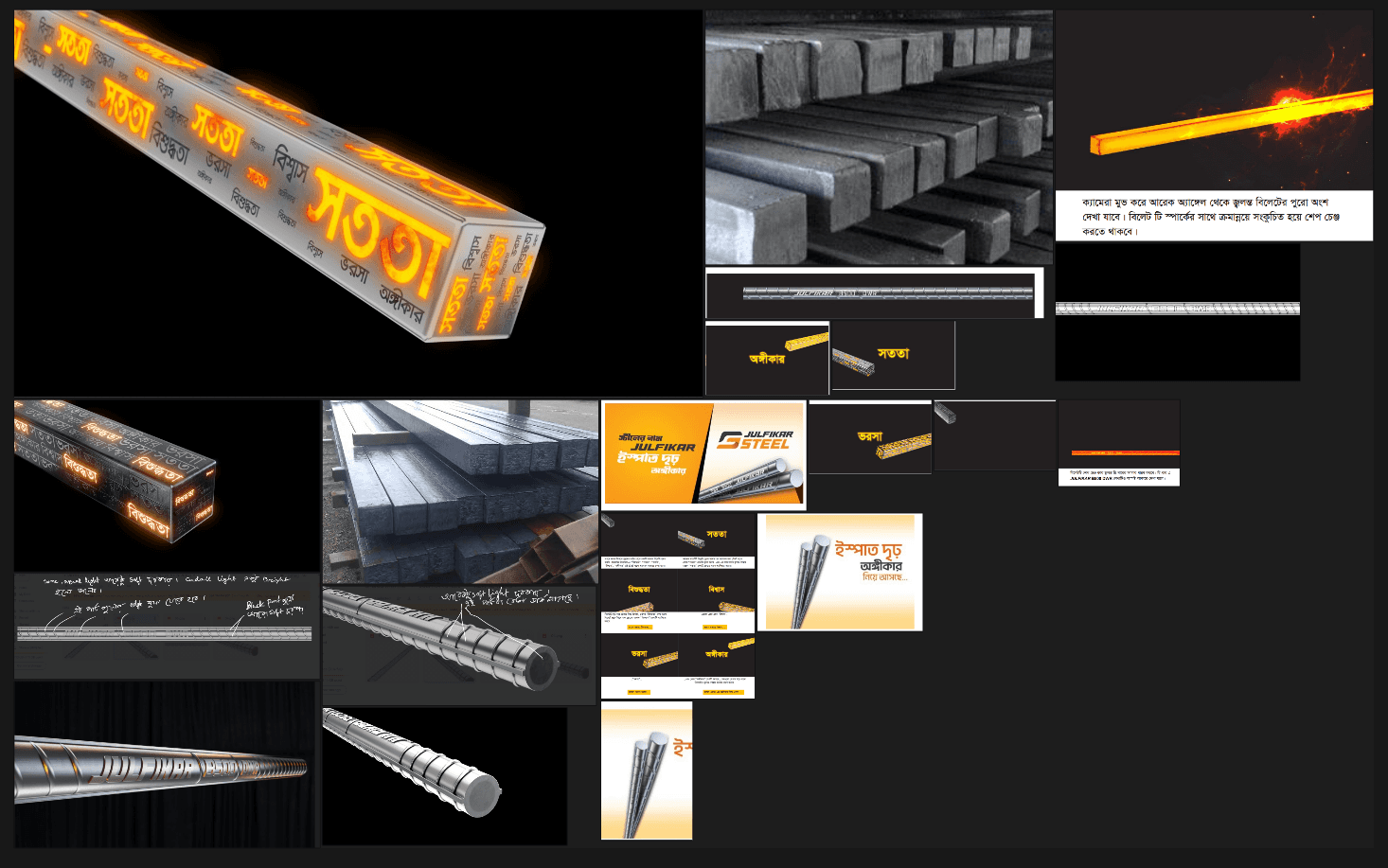
The Blockout Phase
After collecting all the references, we start blocking out our scenes using primitive shapes. In a production environment, where every little step costs money, you don’t want to overwork elements that won’t be seen or don’t serve the story.
For example, in environment design, we often use simple cubes, spheres, and planes to define the scale, silhouette, and spatial relationships of buildings, terrain, and props. At this stage, the goal is not detail—it’s composition. We need to quickly visualize how the camera will move, how the scene reads visually, and whether the elements support the narrative.
By keeping things simple, we can iterate faster, test different layouts, and catch potential storytelling or visual issues early. Once the blockout is approved, we progressively refine the shapes, add details, and replace primitives with final models and assets, always keeping in mind what the audience will actually see.
This phase saves both time and resources, ensuring that effort is spent where it counts, and that the story remains the guiding principle behind every artistic choice.
Modeling & Texturing: Imperfection is Perfection
Here is a secret that separates amateur CGI from professional work: The real world is dirty.
Beginners make 3D models with perfectly straight lines and textures that are flawlessly clean. But in reality, every edge has a slight bevel to catch the light. every surface has micro-scratches, dust, or fingerprints.
Texturing with History

When we texture an object, we don’t just ask how old it is; we ask: "What trauma has this object endured?"
Looking at the render above, the textures tell a violent story:
Impact & Trauma: It’s not just dirty; it’s broken. The shattered headlamp glass isn’t a simple opacity map—it’s a narrative choice that indicates a collision or explosion.
Layering Materials: We simulate physical layers. Notice where the yellow paint has chipped away aggressively to reveal the raw, oxidized metal underneath. This isn't just edge wear; it's structural damage.
Procedural vs. Scanned: We use a hybrid approach. Scanned textures provide the base realism for the painted metal, but we rely on procedural nodes to generate the specific stress fractures in the glass and the random, chaotic chipping of the paint, allowing us to control the exact "age" of the damage without resolution limits.
Lighting & Rendering: Painting with Light
Lighting isn't just a technical requirement; it’s the soul of the render. You can take the best 3D model in the world, light it poorly, and it will look like a cheap video game. Our lighting artists think like cinematographers, using light to sculpt products out of the darkness and guide the viewer's eye to the most important brand details.
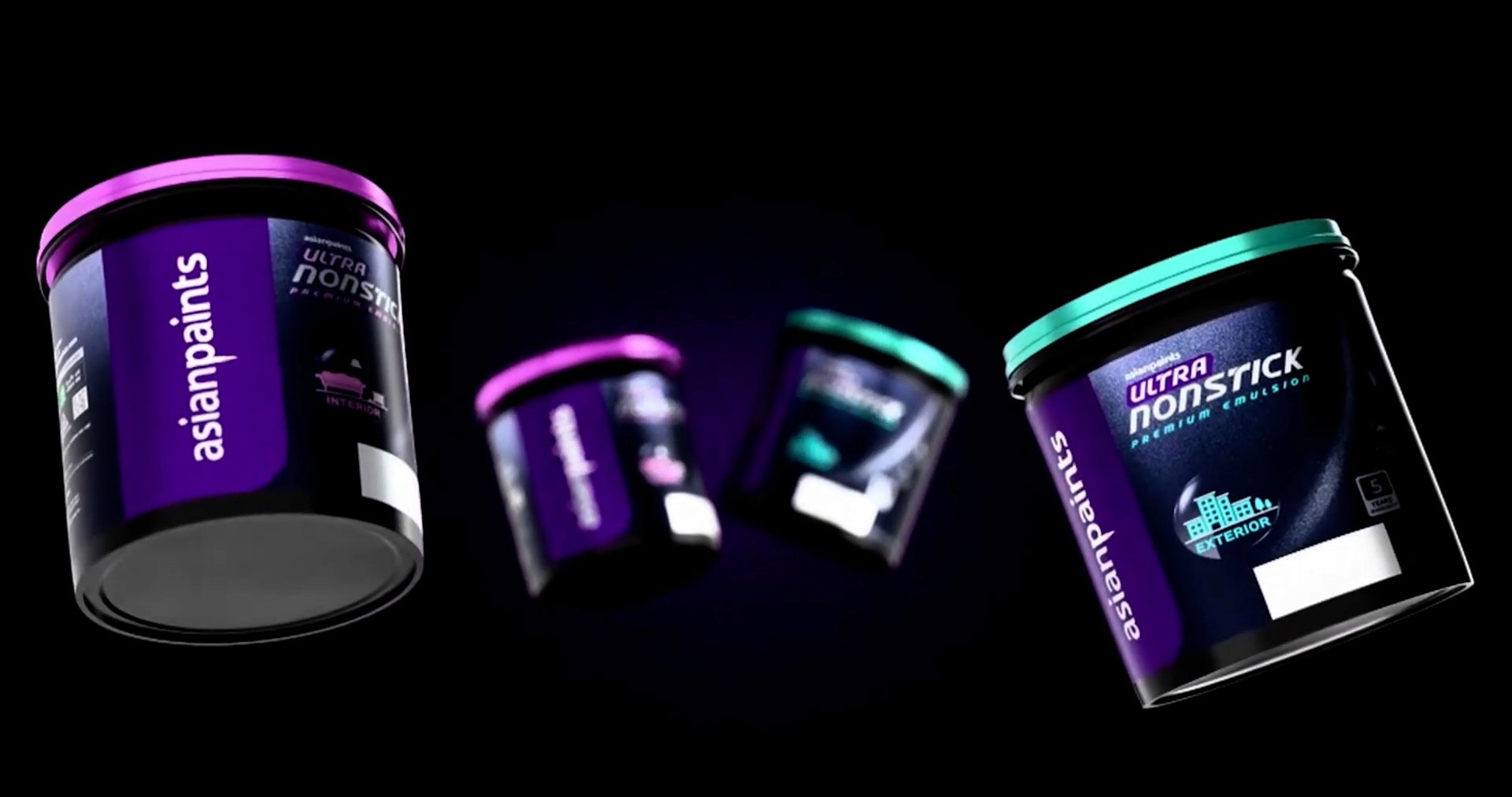
Key Techniques in the "Ultra Nonstick" Series:
Strategic Rim Lighting: Notice how the teal and magenta lids glow against the pitch-black void. We use high-intensity rim lights to define the silhouette of the cans, ensuring the product never gets lost in the background.
The Hero Highlight: A soft, circular gradient is placed precisely on the "Ultra Nonstick" branding. This creates a focal point that ensures the product name is the first thing a customer reads, even in a high-motion, floating composition.
Specular Reflections: By manipulating the "glossiness" of the digital material, we create those sharp, white vertical streaks. This mimics a professional studio softbox, giving the paint cans a premium, metallic, and modern feel.
Global Illumination (GI) & Volumetrics: We calculate how light spills from the glowing lids into the surrounding atmosphere. This creates that subtle purple and green "haze" in the center of the frame, adding a sense of three-dimensional space and atmospheric depth.
The Render Balancing Act
Rendering is expensive (in terms of time and computing power). We constantly balance sampling quality vs. time. We use "denoisers" intelligently—AI tools that clean up grain—allowing us to render faster without losing that cinematic polish.
Animation: Breathing Life into Geometry
As a premier Animation Company in Dhaka, this is our heartbeat. Animation isn't moving things from Point A to Point B. It's about weight, anticipation, and follow-through.
The "Ugly" Phase
We encourage our animators to work in a "blocking" phase first. This looks choppy and rough, like a stop-motion film. We focus entirely on the poses and the timing. If the timing of a joke or an action doesn't land in the blocking phase, no amount of smooth polishing will fix it later.
Micro-Movements
The secret to alive characters? Subconscious motion. Even when a character is standing "still," they are breathing, shifting weight, or their eyes are darting slightly (saccadic masking). These micro-movements bridge the Uncanny Valley.
Technical Deep-Dive: The FireDrum Workflow
For the technical directors and aspiring pros reading this, here is the breakdown of how we actually execute a shot at FireDrum Studios.
1. Pipeline Setup & Naming Conventions
It sounds boring, but if you name a file
final_final_v2.mb, you’re in trouble. We use strict naming conventions and project directory structures so scripts can find assets automatically.We utilize custom Python scripts to automate repetitive tasks (like batch renaming or setting up render layers).
2. Scene Assembly (The Layout)
We use a "Reference" workflow. Assets are referenced into the master scene, not imported. This keeps the file size light. If the modeler updates the character asset, it automatically updates in the animator's scene.
3. Lighting & Shader Implementation
Linear Workflow: We ensure all textures and renders operate in linear color space to prevent "washed out" or overly dark visuals.
AOVs (Arbitrary Output Variables): We don't just render one image. We render "passes"—separate layers for Diffuse, Specular, Reflection, Z-Depth, and ID masks.
4. Compositing ( The Real Magic)
We use Nuke or After Effects to recombine those AOVs.
This allows us to tweak the reflection on a car without re-rendering the whole scene (which could take 10 hours).
We add optical imperfections here: chromatic aberration, lens distortion, and film grain to make the CGI feel like it was shot through a physical camera lens.
5. Quality Control (QC)
Every frame is reviewed. We look for "popping" geometry, texture stretching, or lighting flickers. It doesn’t leave the studio until it’s seamless.
Challenges & How We Solve Them
CGI is hard. Things break.
The Problem: "The render time is 4 hours per frame!"
The Solution: Optimization. We check for overly heavy textures (do we need 8K textures on a background prop?) or expensive sampling settings. We often switch to "Camera Projection" techniques for backgrounds to skip 3D rendering entirely.
The Problem: " The client changed the character design, but we already animated it."
The Solution: This is why the Referencing workflow (mentioned above) is vital. We can swap the character model file, and if the skeletal rig remains the same, the animation applies to the new design instantly.
The Secret Sauce: Our Culture
Finally, the biggest secret isn't software. It's how we work together.
At FireDrum, there is no wall between the "Tech Guys" and the "Creatives." Our developers sit with our artists. If an artist says, "This task is boring and takes all day," a developer writes a tool to fix it.
High-end video production requires a culture where it’s safe to fail early so you can succeed in the final render. We critique the work, never the artist. This psychological safety allows our team to take creative risks that result in truly unique visuals.
Conclusion
Mastering CGI animation is a marathon, not a sprint. It requires a relentless study of the real world, a deep understanding of technology, and a storytelling soul.
Whether it’s keying a green screen, sculpting a creature, or compositing a final shot, every step matters. We hope this peek into our kitchen gives you a better appreciation for the craft or inspires you to tackle your next project with a fresh perspective.
Ready to bring your vision to life?
If you need high-end 3D animation or VFX that stands out, let’s talk.